|
Ho
Home
Pictures Abbey
Seeds
Weaving
Trade
Carving Quakers
Ancient Artefacts
Local Heroes Historic Walk
Family research Museum News
Other museums Links
Top
|
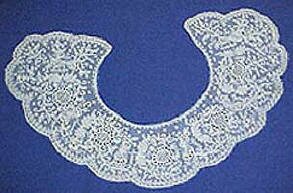
| There is a fine collection of Coggeshall (tambour) lace in the museum. Pieces range from simple samples to a magnificent 19th century wedding veil. The display also includes a piece of unfinished tambour lace still on its wooden frame, lace-making tools and patterns used to mark out the designs. |
| |
|
|
|
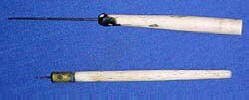
| Tambour hooks used to make Coggeshall lace |
| |
| |
| |
| |
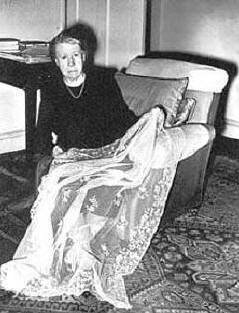
| Left: Edith Surridge |
|
|
A Coggeshall lace collar
|
|
Shown above, displaying a magnificent Coggeshall lace wedding veil, is Miss Edith Surridge, the eldest daughter of a well-known Coggeshall family, who was responsible for reviving the making of Coggeshall lace in the 1930s by forming an association to provide employment for lace workers in their homes and to encourage young women to learn the skill. She, along with Mrs Reginald Hill, brought Coggeshall lace to the attention of Queen Mary and a gift of Coggeshall lace handkerchiefs was sent to Princess Marina on the occasion of her marriage to the Duke of Kent.
| |
|
|
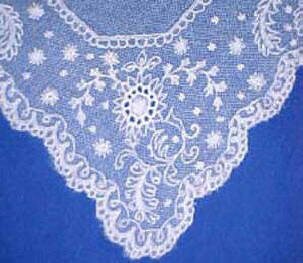
|
|
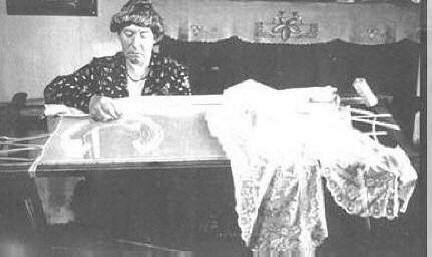
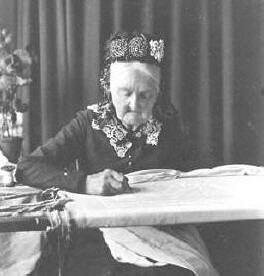
Coggeshall lace maker in her home working at her frame
|
Detail of a Coggeshall lace table mat
|
|
| |
| A Brief History (Information from the work of the late Jean Dudding) |
| About 1812 a French émigré, M. Drago and his two daughters settled in Coggeshall, Essex. Here they hired a room and began to teach the women and small children a method of decorating this net by using a tambour hook. Thus began the making of Coggeshall Lace (sometimes called tambour lace). Tambouring produces a line of chain stitches and originated in the Far East, where the workers used a round frame resembling a tambourine or drum. This they could grip between the knees, thereby releasing both hands for tambouring. Coggeshall workers used a rectangular frame and this type is still used today. |
| Throughout the 19th century this tamboured net lace was made in the tambour rooms and cottages of Coggeshall, and also in the homes of surrounding villages. Lace manufacturers and lace dealers co-ordinated these workers by obtaining orders from London and elsewhere. Sometimes more sophisticated designs were introduced and these would be tamboured by the more proficient workers. Besides the designs, all the necessary net and threads would also be distributed to the lace workers. Liberty & Co., amongst others, were supplied with Coggeshall Lace. |
| The fluctuations in prosperity of the tambour lacemakers were governed by many factors. Fashion requiring flounces and frills gave great encouragement but the invention of chain stitch sewing machines and of machine made laces imitating the hand made article, together with a deterioration in the quality of design meant hard times for the laceworkers. Just after 1900 there was a great improvement in the quality of Coggeshall Lace. This was due largely to the activities of two ladies, the Misses Spurge, who were the chief employers in the district. Their brother William was an art teacher who improved the general standard of design and also introduced some old Italian designs. The First World War resulted in a decline in the making of Coggeshall Lace. The workers found it more profitable to do tambour beading. |
| In the 1930's a determined effort was made to revive the making of Coggeshall Lace, and three handkerchiefs were given to Princess Marina on her marriage (See below). Coggeshall Lace was made into dresses for the Queen, Princess Margaret and Princess Alexandra. This work was undertaken by three very proficient workers in Great Tey. Queen Mary also chose two lace dresses and a teacloth in Coggeshall Lace. It was hoped that this Royal Patronage would encourage a revival of the craft. However the financial return was too meagre and after the Second World War both net and threads disappeared. Today Coggeshall lace is made by some members of the Lacemakers Guild and is taught as part of the City and Guilds course. |
| Mrs Dudding's books are available for study in the museum |
 |
|
|
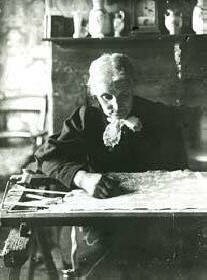
| Believed to be Nurse Ardley, town nurse and lace maker. Died in 1916 in her nineties |
Taken from a glass photographic plate, c1900 |
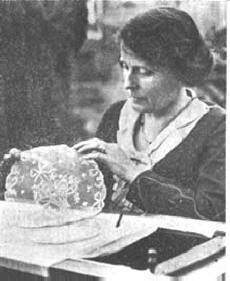
Mrs Percival with the tablemat that she made as a wedding gift for a Royal lady-in-waiting in the 1930s |
| |
| A link to Royalty |
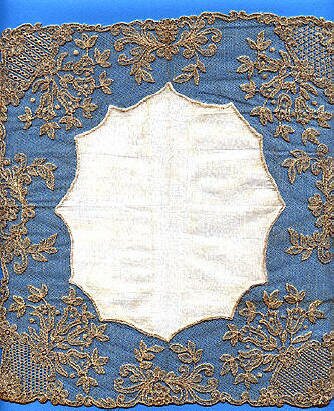
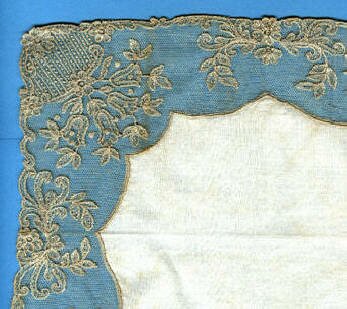
| A copy of one of the handkerchiefs sent to Princess Marina on the occasion of her marriage on 29th November 1934 to the Duke of Kent, the fourth son of King George V, has been donated to Coggeshall museum by a Colchester gentleman. The handkerchief had been given to his mother many years ago by Mrs Lester who had made two of the handkerchiefs that went to the Princess. |
| |
| |
|
|
|
|
|
|
|
A copy of the 'royal' handkerchief
|
|
Close-up detail
|
| |
|
|
|
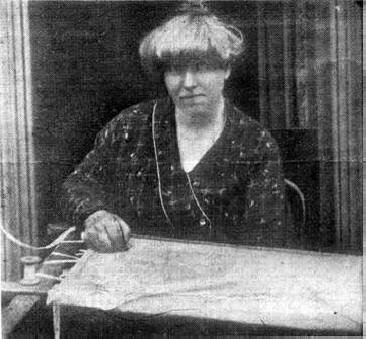
| A newspaper picture shows Mrs Lester at work on the frame on which she made one of the handkerchiefs. It was worked from a hundred-year old design originated by her grandmother. |
| |
|
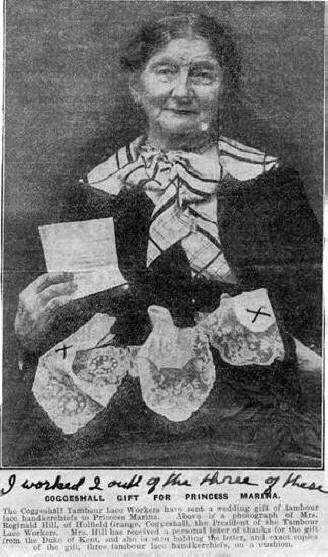
On the right is a newspaper photograph of Mrs Reginald Hill of Holfield Grange, Coggeshall, the President of the Tambour Lace Workers. Mrs Hill received a personal letter of thanks for the gift from the Duke of Kent, and is seen holding the letter and exact copies of the gift, three tambour lace handkerchiefs, on a cushion. Mrs Lester had marked the handkerchiefs that she had made - on the right is the one now in Coggeshall museum.
|
|
|
|
| |
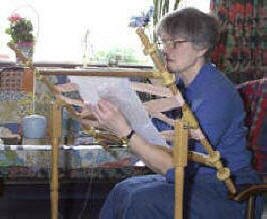
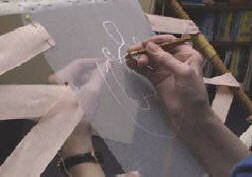
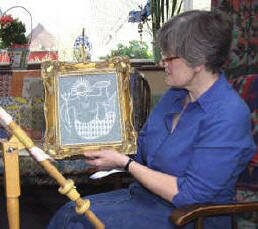
| A modern Coggeshall lacemaker |
 |
|
|
| Mrs Sue Game, a modern Coggeshall lace-maker, at work in her home. Mrs Game teaches the art of tambour lace-making and is a volunteer at the museum. The work in progress on the frame is a picture of a mermaid.The merman(above) is now in the museum. |
| |
|
|
|
|
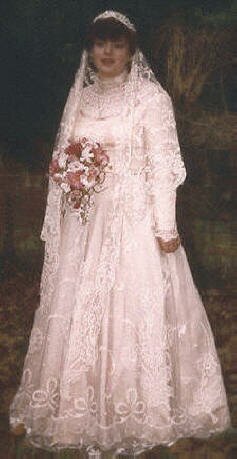
A 1984 picture of an old lace wedding dress. The dress was in two pieces, the skirt being made of old Coggeshall lace. The bride was stitched into the dress to prevent it coming apart !! |
|
