|
Home
Home
Pictures Abbey
Seeds
Weaving
Lace Trade
Quakers
Ancient Artefacts
Local Heroes Historic Walk
Family research Museum News
Other museums Links
Top
|
| There has always been a history of wood carving in Coggeshall as may be seen from the carved friezes on the outside and the finely-worked panelling on the inside of ancient houses. The church of St Peter-ad-Vincula bears witness to the skill of craftsmen in the 19th-century church restoration and they were the masters who passed on their skills to the carvers of our own time. |
| William Polley |
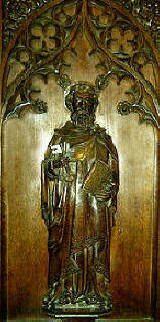
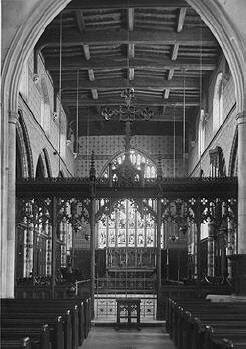
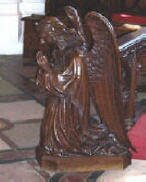
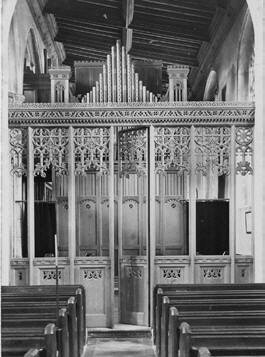
| William Bally Polley of Church Street was responsible for the pulpit which was installed in 1871. It is made of oak and the central panel bears the figure of St Peter with his crossed keys. The kneeling angels at the altar rails are his work, as well as the Rood screen which he made in 1891 and the organ case in 1896 (the latter two are longer in existence). |
|
|
|
|
|
The figure of St Peter on the pulpit
|
|
One of the carved angels at the altar rails |
| |
The Rood screen topped by the huge cross
|
|
| The Beckwith family |
|
Ernest Wicken Beckwith, born in 1872, was apprenticed to Polley at the age of thirteen and would undoubtedly have worked on the screen and the organ case as his talent for carving was recognizable from his early years. By 1892 Beckwith had his own business carving and restoring antique furniture at the back of a house in East Street which the family were to occupy for the next 80 years. This family can be considered to be the foremost of the Coggeshall woodcarvers.
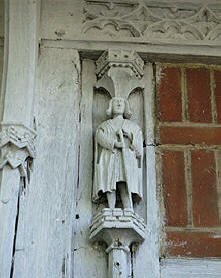
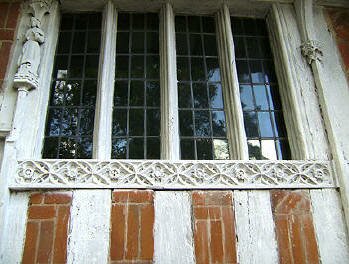
In 1908 Ernest was commissioned to restore Paycocke’s, the richly carved wool merchant’s house in Coggeshall which subsequently became the property of the National Trust. All the windows and some of the carved figures on the front are his work but executed in old oak so that present day visitors may well think they are original. One of the visitors to Paycocke’s during its restoration was W. F. Crittall, founder of the Braintree metal window firm, and this led to a partnership with the Critall family lasting for over forty years with Ernest was making a lot of furniture for their offices, boardroom and family homes. Lychgates for churchyards were erected in large numbers as First World War memorials and the Beckwith workshop often had one of these huge pieces of joinery under construction.
|
|
|
There are many pictures of the front of Paycockes.
Here are two which show the detail of the doorposts and window surrounds that were carved by E. W Beckwith. The bright white colouring is lime wash which is a traditional wood preservative.
|
|
|
Partly due to the patronage of local wealthy families the workshop survived the economic depression of the late twenties without creating redundancies and through the following decades Beckwith continued with ecclesiastical and restoration work all over the county and beyond. Ernest died, aged 80 in 1952 but had continued to carve until a few months before his final stroke. One of the last pieces of work he completed was the cross and candlesticks for St Peter’s in Coggeshall.
In 1923 Beckwith’s son Edward joined the family workshop. It seems to have been a somewhat reluctant obligation to family loyalty as his first choice was as a wireless operator in the Royal Navy. At the beginning of the Second World War Edward was conscripted into the War Office because of his keen amateur experience with radio but returned to the family firm when peace came.
After Ernest’s death the craft tradition and the shop selling antique furniture carried on, but unfortunately Edward was not a good businessman and lacked motivation to work and maintain the business. Within a year or so the last employee was paid off and the business and customers rapidly declined.
|
|
|
|
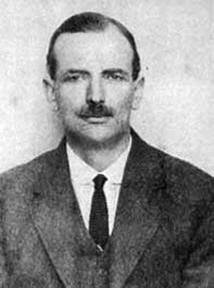
On the left is E. W. Beckwith, the master carver responsible for the work at Paycockes in 1908.
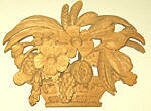
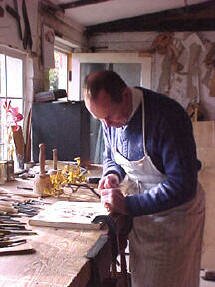
On the right is Andrew Beckwith, the grandson, who is a talented carver and furniture designer. The carved fruit and flowers above are his work
|
|
|
| Andrew, Edward’s son left school at 15 decided that he would like to try his hand in the family business. Although Andrew had inherited his grandfather’s talent the venture was a disaster from the start as Edward was not interested in teaching and failed to motivate his sons. On a snowy January day in 1963 Andrew tramped the streets of Ipswich seeking work as a cabinet maker. He was taken for trial period by an old county firm of antique dealers and furnishers, Green and Hatfield of Northgate. In addition to gaining experience of antique furniture restoration he occasionally had to go to illustrious addresses for repair work to ancient panelling and his skills increased considerably. Later Andrew became a partner in a small antique shop running it and restoring furniture from a backroom workshop while his partner did the buying. The years together were successful and enjoyable, but personal crises intervened and Andrew spent time in a religious community. But furniture making was never far away as the community chapel was being re-ordered during the 1960s and he was asked to make much of the new furniture. He returned to Suffolk and cabinet making in his home workshop, largely doing restoration work for the antique trade for the necessary income to survive, still years away from realising his wish to create his own style of furniture. In 1992 Andrew returned to Coggeshall after an absence of 30 years and began to acquire local commissions. Changing circumstances made a move to the tiny village of Bowsden in Northumberland necessary and Andrew continues to practise his craft there. In 2007 he was commissioned to make the new organ case for St Peter’s church, just over a century after his grandfather Ernest had done the same. The new case is now installed and pictures will be taken of the work - so watch this space! |
| |
| Samuel Marshall |
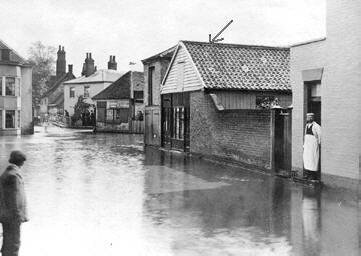
| Samuel Marshall was born in 1855 and had his workshop in Bridge Street. He was responsible for the carved figures in the sanctuary roof of St Peter’s and, in 1902 and 1903, worked with Beckwith on the screens of the side chapels. In 1907 he took as apprentice a fourteen year old local lad, Bryan Evett Saunders, who was to prove a talented carver. Sam Marshall worked in Bridge Street until the 1920s and died in 1934, aged 79. |
|
|
|
Above: Sam Marshall's premises (arrowed) in Bridge Street flood of 1903.
|
|
| On the left is one of the screen in the church carved by Sam Marshall. |
| |
| Bryan Saunders |
| Bryan Saunders apprenticeship finished in 1914 and he tried to enlist in the Forces but was turned down. In 1919 he set up his own workshop on Market Hill, a house he was to occupy with his wife and two daughters until his death in 1973. Commissions both large and small came his way and he was so busy that in 1929 he took on an assistant, Ernest Prentice, a qualified carver who had served his apprenticeship at Marshall’s alongside Bryan. The business thrived but the advent of World War Two brought changes for both Bryan and his assistant. They first worked at Marconi’s in Chelmsford and later on Bryan was called upon to utilise his skills by making special boxes for secret documents. After the war he was back in Coggeshall following the craft that he loved, although Ernest never returned to full-time carving, and the post-war years were busy ones with Bryan’s reputation for fine carving spreading far beyond his native Essex, even to the USA. |
|
But his health was deteriorating and eventually he was diagnosed as suffering from cancer. Typically, he carried on working until just weeks before his death which came peacefully at home, with his wife and daughters at his side, in 1973. His work is in many churches and homes and the seats he carved for the commemoration of the Festival of Britain in 1951 can be seen in Coggeshall at the present day. His daughters have donated his workbench, tools, papers and unfinished work to the National Trust and it is now housed as a separate exhibit in Coggeshall Grange Barn.
There have been other men who have practised the art of woodcarving as part of their other businesses as cabinet makers and joiners, but the men mentioned here are considered to be foremost in the craft.
|
|
|


