|
|
| |
|
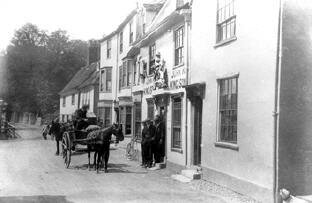
| John King founded the firm in 1793 and it was greatly enlarged by his son, John Kemp King, until it was the world's biggest wholesale supplier of seeds with offices and trial grounds near Reading as well as in Coggeshall. |
|
|
|
|
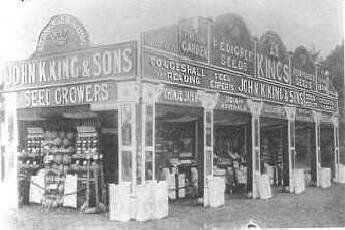
| A fine display of wares from J. K. King. This was taken at the Royal Norfolk show in about 1908. |
|
J. K. King held Royal warrants from Queen Victoria and the Prince of Wales (later King Edward VII) |
| |
|
| John K. King married twice. William, the son from his first marriage, ran the family brewing business. The sons from the second marriage, Herbert and Leonard, went into the family seed business and there appears to have been discord between the half-brothers. When William's son Ernest left school he asked his grandfather for a job in the family seed firm. His grandfather refused and the young man left, vowing that one day he would own his grandfather's business. In 1888 he acquired a small shop near his grandfather's establishment in West Street and the firm of E. W. King was founded. By 1893 E. W. (as he was known by all) had moved across the road to a shop on the corner of Bridge Street and West Street behind which was a three-storied warehouse. |
|
|
|
|
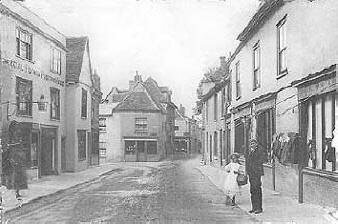
| The shop of E. W. King can be seen in the centre of this picture. |
|
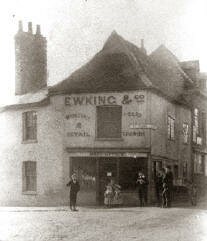
A closer view of the shop on the corner of Bridge St. |
| |
|
|
By 1904 he had moved to much larger premises on Grange Hill and acquired land in Little Coggeshall to grow seeds of all sorts, but especially sweet-peas, for which the firm of E. W. King became (and still is) world-famous. The rivalry between the firms was bitter and extended to the workforce, who even went to the lengths of drinking in different public houses.
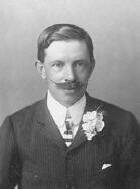
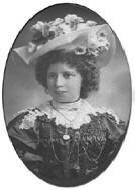
| Ernest King - it is said that he always wore a buttonhole of sweet peas, no matter the time of the year. On the right is his sister Louise who died in 1920 at the early age of 23. |
|
|
|
|
|
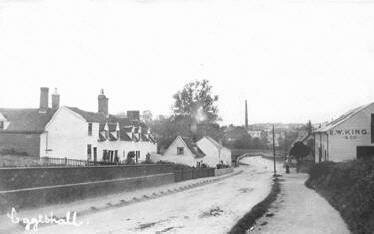
| This 1906 picture shows Grange Hill with E. W. King's seed warehouse. The tall chimney that can be seen on the skyline belonged to J. K King. |
|
| |
|
|
|
|
|
|
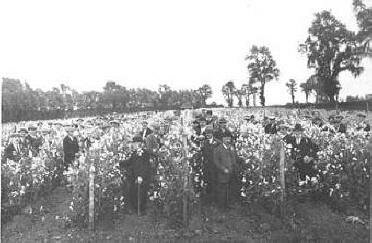
| Members of the Sweet Pea Society at E.W. King's trial grounds at Coggeshall Hamlet, 1928 |
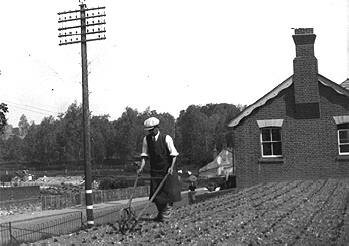
Bill Brown tending the seed beds at E.W. King's premises on Grange Hill - about 1948 |
| |
|
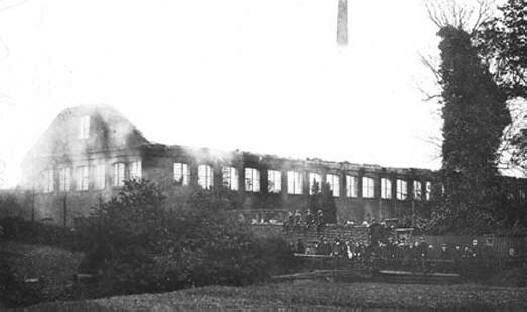
| In 1917 tragedy struck. Herbert King was killed by a German bomb on a London station. Further disaster followed when, in 1920, a huge warehouse fire broke out at the Orchard House site destroying thousands of pounds worth of seeds in minutes. The local fire brigades struggled in vain to contain the fire, but a high wind fanned the flames and within 20 minutes the whole roof of the 2,000 square-foot building had fallen in. |
|
|
|
Children watch the fire at the warehouse of J. K. King. May 1920
|
| By now the firm was in deep trouble, so E. W. was approached to take over the running of J. K. King as well as his own large firm, thus fulfilling his vow, but not in a way that gave him any pleasure. The firms kept their separate identities and E. W. ran them until his death in 1930. A charitable man, E. W. left money in his will to build almshouses and set up a trust which still distributes money to this day. The firm of E. W. King passed to his godsons. J. K. King was sold to Francis Nicholls whose family continued to run it under the J. K. King name for many years. The firm of J. K. King was responsible for the founding of Coggeshall's football club in 1878, and members of the family, as well as employees, were keen players. The team was also well supported by other smaller seedsmen and nurserymen in the area and is still known as "The Seedgrowers". |
|
Both firms have now moved out of Coggeshall but both of the names are still in use. E. W. King is now at Kelvedon and continues to grow flower and vegetable seeds which can be bought in local as well as national outlets. J. K. King is part of Associated British Foods with its administrative headquarters near Peterborough. The seeds grown By J. K. King are used in the manufacture of drugs, cosmetics, the food industry and even in the making of plastics.
|
|
|
